

How to talk climate with conservatives.
Last month, I was fortunate to attend the Conservative Climate Summit, hosted by Utah Senator John Curtis on the University of Utah campus. I’d looked forward to the event for weeks leading up to it. But when I told colleagues and friends I’d be going, not everyone shared my enthusiasm.
“Why would you do that?” asked one.
“Isn’t that an oxymoron?” said another.
Based solely on the news headlines we’re seeing on the daily, these responses might seem understandable. We’ve got Trump raging against windmills. A horror-spree of climate policy rollbacks. And the sellout of our most pristine public lands for oil and gas drilling.
But what we don’t hear about are the bipartisan collaborations happening right now on climate initiatives like the Fix Our Forests Act and the American Prairie Conservation Act. Most of us are also unaware of the growing number of conservative-led coalitions focused on environmental issues, such as the Citizens for Responsible Energy Solutions (CRES), the Conservative Climate Foundation, and the American Conservation Coalition.
In our hyper-polarized environment, we also forget that most of us in America ultimately want the same things: To live in communities with clean air and water, and to protect the places we love for future generations.
And yet the word “climate” hasn’t exactly been rolling off the tongues of most Republicans. At the Summit, Curtis revealed that he likes to challenge his hardcore Republican colleagues to say the word aloud. “It makes them really uncomfortable,” he said, flashing a mischievous smile.
But Republicans are comfortable talking about energy innovation and land stewardship—and increasingly, they’re stepping directly into environmental conversations, albeit bringing a different voice than what we’re used to hearing. Case in point: I heard more talk about “permitting reform” in just one day at the Conservative Climate Summit than I’ve heard in all my years working in sustainability communications. This was a good thing! I learned a lot!
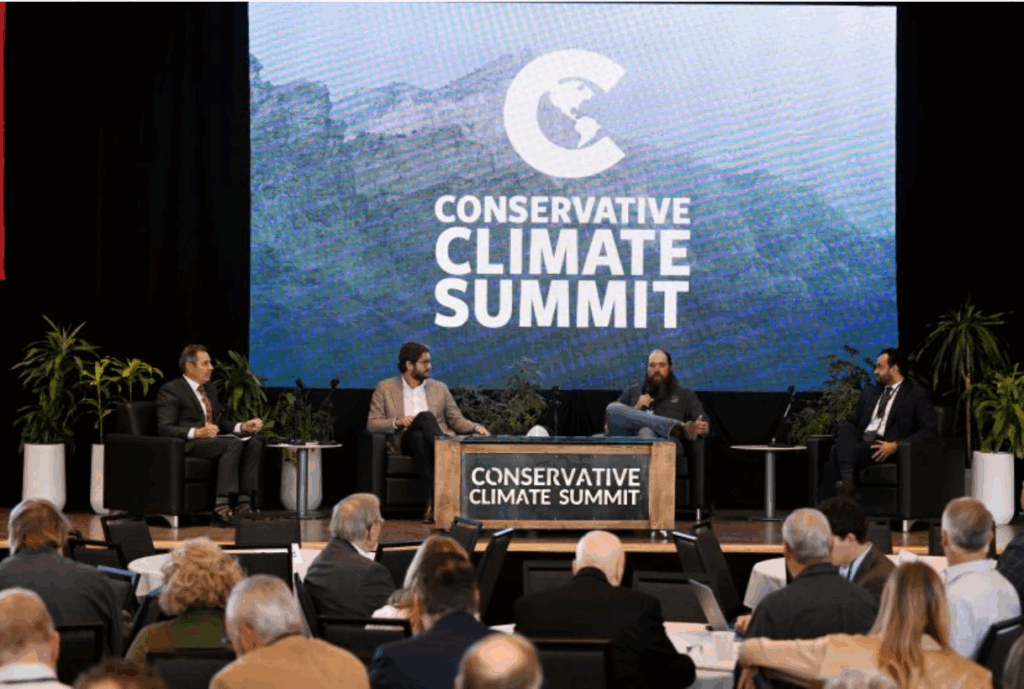
Words I heard. And what we can learn from them.
One of my favorite parts of the Summit was just listening to how conservatives talk about protecting our planet. For starters, they most definitely didn’t use words like “climate crisis” or “environmental justice.” Some of the language they used had a clear Republican tone and reflected the current administration’s priorities. But most of it had a neutral tone—it didn’t sound connected to either party.
Working like an amateur ethnographer, I took pages of notes cataloging the words and phrases I heard throughout the day. And like any good ethnographer, I analyzed my data. The most Republican-centric climate language focused on security, independence, and innovation. The more neutral phrases tended to highlight things like resilience, health, and affordability.
Republican-centric language
If you’re communicating about environmental issues to conservatives ONLY, and you can slip in phrases like these—which came up a lot at the Conservative Climate Summit—ears are likely to prick up.
- Energy dominance
- Energy independence
- Energy abundance
- National security
- Permitting reform
- American innovation
- Market-driven innovation
Words with bipartisan appeal
For broad appeal, which is what we’re typically going for in our communications, try words that aren’t tied to either political party. These words came up often at the Summit and provide good guidance for nonpartisan language that conservatives can get behind.
- Community resilience
- Energy resilience
- Affordable, reliable, clean energy
- Clean air and waterways
- Conservation
- Stewardship
- Preservation
Beware the environmental binary.
While checking out all the vendor booths at the Summit, I picked up this card from the American Conservation Coalition, a youth organization focused on building the conservative environmental movement.
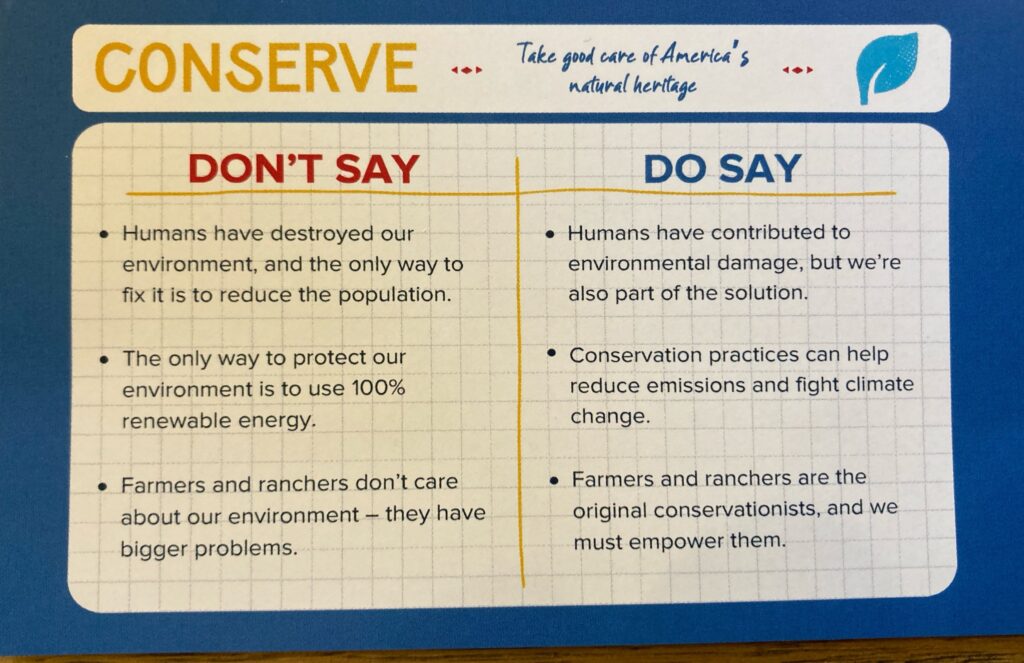
While the Don’t Say column forces audiences to choose between opposing viewpoints, the Do Say column removes the “us v. them” environmental binary—allowing more people to see themselves in the solutions.
And let’s face it, we need more people—Republicans in particular—in this work. It’s far beyond time to put down our swords and find more ways to collaborate on climate issues. This message I heard at the Summit rang particularly true: One side of the aisle shouldn’t be solely responsible for protecting our environment.
As Senator Curtis put it, “we have a much better debate on energy and climate policy when there are Republicans at the table putting their ideas forward.”
Now we just need to make sure we communicate in a way that actually invites them to that table.
Our Most Recent Insights.
SEE ALL INSIGHTS →
Storytelling
How to get more people to care.
Aha! moments from our most recent sustainability communications workshop.

Storytelling
A future that’s better than break even.
Lessons from a sustainability pioneer on hope, impact, and action.
Storytelling
Communicating without polarizing.
Protect your messages against cultural and political pendulum swings.