

Get your sustainability initiatives funded.
Getting buy-in and funding for your sustainability programs isn’t easy.
Finance executives may think these initiatives are too expensive. Operations leaders often have higher priorities. And other senior leaders might worry that these efforts will distract their teams from core business activities.
But the truth is, every day that organizations don’t take action to address environmental risks costs them money. According to the World Economic Forum, businesses will lose $560-610 billion per year due to climate hazards.
Earlier this year, we had the opportunity to work with The Commonwealth Fund and 12 health system sustainability leaders to create a guide for communicating their climate initiatives to different audiences—and winning their support. We captured insights from leaders across the country who’ve found the right messages and strategies for overcoming executive pushback, getting organization-wide buy-in, and finding the resources they need to bring their ideas to life.
We also drew on years of working with sustainability clients across industries to craft practical advice and tips you can start using in your own organization right away.
While the guide was developed for healthcare sustainability leaders, the strategies we uncovered can help leaders in any industry get their messages heard and inspire audiences to act. Here’s what stood out again and again.
Tie your projects to business objectives.
Being passionate about your work will only get you so far. If you want people to get behind your ideas, connect sustainability directly to your organization’s goals and show how it moves the business forward.
That could mean demonstrating how reusable products reduce waste and costs. Or how upgrading to LED lighting improves safety while reducing energy use and environmental impact.
When people can see how your project contributes to priorities they already care about, you’ve flipped the conversation from “nice-to-have” to “must-do.”
Find a champion.
It’s much easier to gather support when your message is coming from someone your audience already trusts.
That champion could be a facilities manager committed to saving energy, a clinician who knows cleaner air helps patients heal faster, or a senior leader who cares deeply about climate health.
In some cases, health systems recruited a spokesperson from each service line—like a surgeon in every department—to ensure sustainability messages were delivered peer-to-peer. Champions help make the work feel relevant, credible, and achievable.
Talk to what people care about.
Frame your initiatives in a way that makes them personally relevant to the people you’re speaking to. For example, while finance teams typically care more about long-term cost savings or ways to cut waste, marketing teams may want to know how sustainability can strengthen brand reputation and customer loyalty. On the other hand, operations leaders are most likely interested in how these projects increase efficiency, reduce risk, or prevent expensive delays.
One sustainability leader described it as figuring out what story the person across the table needs to hear. That requires listening first—understanding priorities, asking questions, and starting from common ground.
Build on existing initiatives and communication channels.
Spreading the word about your environmental work shouldn’t be done in isolation. Build on existing communications efforts in your organization that support programs to reduce waste, cut costs, or improve efficiencies.
These joint communications can help you show how closely your organization’s values are linked to sustainability goals, commitments, programs, and initiatives.
By aligning with current processes, you avoid competing for attention and resources, and you make sustainability a part of everyone’s daily work. You also tap into your company’s communication channels and teams, helping more people understand the value of following sound environmental practices.
Speak in clear language.
If you want people to understand and support your work, talk in words they understand. Rather than using scientific terms or political jargon, translate them into relatable human experiences instead.
For example, while sustainability teams might use terms like “carbon emissions,” people outside the field can relate more to “pollution.” Technical phrases like “net zero” can be swapped for clear explanations that speak directly to people’s daily lives, like having cleaner air to breathe or safer drinking water for their families.
And, nothing adds clarity like numbers. Be sure to back up your stories with stats that allow stakeholders to see how your efforts tie back to their business goals.
Learn more from the full guide.
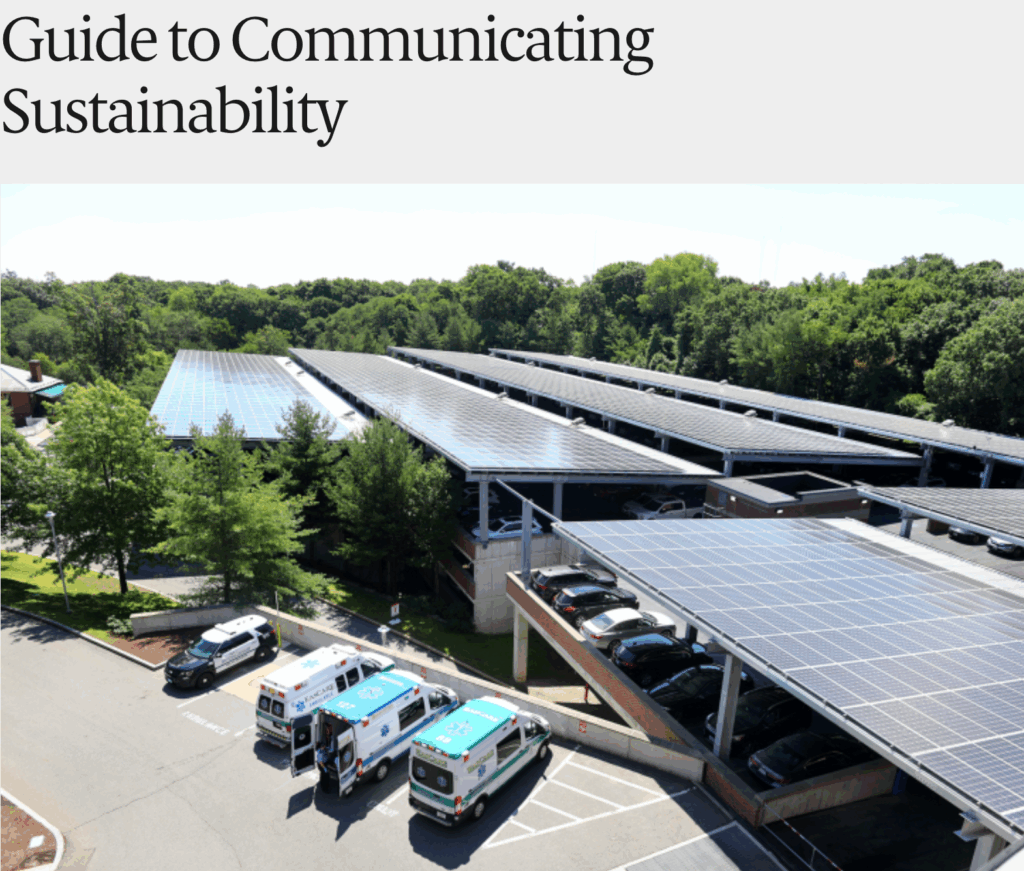
The Commonwealth Fund’s Guide to Communicating Sustainability offers more real-world tips like these, plus practical tools you can use today. Inside, you’ll find:
- How to tailor your sustainability message for different audiences
- A jargon-buster to help you replace technical terms with language that resonates
- Best practices for weaving sustainability into existing organizational priorities
- A curated list of resources for deeper learning
No matter your industry, these approaches can help you move from good ideas to meaningful action, while bringing more people along for the journey.
Acknowledgements
We’d like to extend our gratitude to the health system leaders who so generously contributed their time in making this guide possible:
Dr. Michael Boninger
Chief Medical Sustainability Officer, UPMC; Associate Dean for Sustainability in Health Sciences, University of Pittsburgh (PA)
Dr. David Callaway
Chief, Crisis Operations and Sustainability, Atrium Health (NC)
Dr. Ilyssa Gordon
Formal Medical Director for Sustainability, Cleveland Health Clinic (OH)
Terri Scannell, MBA
Principal Advisor, Sustainability and ESG, Ohio Health (OH)
Dr. Seema Wadhwa
Executive Director, Environmental Stewardship, Kaiser Permanente (VA)
Cecilia Deloach Lynn, MBA
Vice President, Sustainability, Advocate Health (WA)
Dr. Gregg Furie
Medical Director for Climate & Sustainability, Brigham and Women’s Hospital (MA)
Mike Geller
Sustainability Manager, Providence Health & Services (OR)
Dr. Laura Gould
Director of Quality, Medical Education and Population Health, Lawrence General Hospital (MA)
Elizabeth Joseph, RN
Nurse Practitioner, Jackson Health System (FL)
Dr. Kyle Tafuri, MBA
Vice President, Sustainability, Hackensack Meridian Health (NJ)
Dr. Smitha Warrier
Chief Surgical Operating Officer, Medical Director of Environmental and Social Sustainability, University of Utah
Our Most Recent Insights.
SEE ALL INSIGHTS →
Strategy
Make the truth memorable.
The stories we tell, and how we tell them, can help keep trolls and untruths at bay.

Storytelling
Why science needs stories.
By combining data with stories, we make meaning from information.

Strategy
How to talk climate with conservatives.
Many conservatives care deeply about the environment. They just talk about it differently.