

Change happens. Time to reinvent.
At the end of my freshman year in high school, I tried out for cheerleader. It was pretty much a formality — I had been a cheerleader for the previous four years, I already knew all chants, cheers, and routines, and I oozed spritely spirit. Then, I didn’t make it. When I came home and dissolved into tears, my mom thought I was joking. Turns out, while my skills were sharp, my lack of academic focus cost me some valuable points. It was a crushing blow to my identity that also became a pivotal moment. Mom said I could either walk around with the mulligrubs (her softer word for self-pity) or get serious and try again next year. I decided to double down and make the needed changes to guarantee success. Then a funny thing happened: in my year of reckoning I got involved in school plays and student government, I got serious about my schoolwork, I played soccer and tennis. And I discovered I wasn’t a cheerleader.
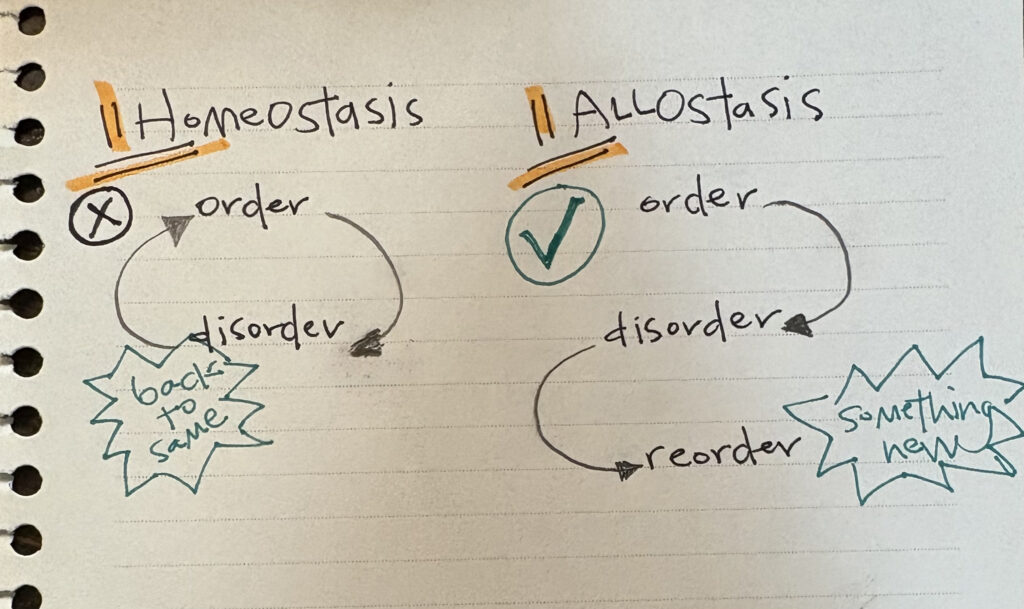
For those of you following my writing and thinking, you know I reference a lot of Brad Stulberg’s work and especially his latest book, Master of Change: The Case for Rugged Flexibility. It’s a playbook for how we respond when disorder descends. In his book and this article, Stulberg makes the case that to resist change by hoping or wishing for things to go “back to normal” (homeostasis) is not how we move forward. Instead, the period of disorder should be where growth happens (allostasis). And Stulberg believes that we need both strength and flexibility in order to successfully navigate the chaos and persevere over the long haul.
Last week, Fast Company’s article “How ‘Business for Good’ Went Bad—And What Comes Next” explained how the surge in stakeholder capitalism (a.k.a. corporate sustainability) has not only peaked but is currently in a rapid decline. On the heels of that piece was a Bloomberg article, “Big Business is Abandoning its Climate Goals.” Not great news for those of us working in sustainability. They point to the likely culprits: ESG becoming a dirty word, activist-inspired consumer pressure, economic penalties on certain policies, overambitious goals, corporate leaders going quiet.
When taking a hard look into what’s happened, the Fast Company article argues it isn’t just political backlash or market correction—it’s deeper. It’s lack of consensus around what defined conscious capitalism, misalignment between consumers’ desire to be sustainable and act sustainably, regulation confusion and its voluntary nature, and weak ambition. As I was reading, it occurred to me that we’re living through a classic pattern of disorder, and in this moment, companies face a critical choice (defined by another Stulberg concept): will they retreat to the comfort of negative freedom—freedom from accountability, scrutiny, and hard tradeoffs—and futilely try to return to homeostasis? Or will they embrace positive freedom—the freedom toward hard things in service of something bigger— and adopt allostasis? For those who accept change, there will be reinvention.
To further the analogy, I mashed up the Fast Company article’s corporate sustainability timeline, Stulberg’s framework, and what we know about sustainability communications.
➡️ ORDER: This was the era of companies creating a bold new identity rooted in positive freedom, built on purpose, and anchored by mission-aligned work, ESG programs, and feel-good capitalism.
- Startups and major corporations alike embraced values like sustainability, DEI, and purpose-driven growth.
- Companies aligned mission and values with the pursuit of meaning, equity, and climate action alongside profit.
- Institutions like B Lab, Fair Trade USA, and even the Business Roundtable formalized this order.
- Communications focused on publicizing commitments, reporting progress, and storytelling around programs and initiatives. Startups and major corporations alike embraced values like sustainability, DEI, and purpose-driven growth.
➡️ DISORDER: The idealistic order collapsed under economic pressure, political backlash, and cultural fatigue, revealing cracks in corporate commitment and the need for deeper alignment
- Economic stressors like inflation, interest rate hikes, and layoffs impacted company’s commitments.
- Public disillusionment was seeded as companies scaled back commitments under pressure.
- Critics exposed ESG efforts as shallow or performative.
- Political backlash came from right-wing activists.
- Greenhushing showed up in the form of altered language, quieted communication of polarizing programs, and downgraded discussions on sustainability from senior leadership
➡️ REORDER: Instead of hoping for back-to-normal days and eventually collapsing, the most resilient companies will evolve: leaning into discomfort, sharpening their practices, and recommitting with more clarity and truth.
- Companies must decide if they are truly committed to sustainability and equity.
- The next generation of corporate sustainability will need companies to talk openly and honestly about their successes and failures, and maybe even their backpedaling when things got thorny.
- Applying rugged flexibility could see companies rethinking their values and communicating this evolution with relatable narrative and clear, concise messaging.
- Letting go of the fear and resistance to change that defined the disorder period opens up opportunities for more meaningful, transparent sustainability communications along with the ability to make a real impact.
“It would be disingenuous to say that this moment doesn’t create some angst that we’re going backward. But we’re lucky. We get to set our rules. We can stay focused on the long term. The pendulum swings back and forth.”
—Bombas CEO Dave Heath
As unsettling as these recent articles are for me, one positive bit was that truly mission-driven companies are undeterred. And I was relieved to see companies like NatureSweet, Bombas, Blueland, Dr. Bronner’s proudly willing to speak out for this article alongside a few of the OG conscious capitalists like Ben & Jerrys and Patagonia.
In our angst, we can turn to nature for living examples of the beauty that can come out of disorder (or disaster). After disaster in Chernobyl, the landscape in the Exclusion Zone transformed from urban to ecological, with lush green plant life consuming abandoned buildings and free-ranging wolves, lynx, bears, and birds roaming in what used to be a busy city. While this moment isn’t quite nuclear, we’ve certainly reached our reckoning.
The chaos is causing companies to reevaluate. And sure, that feels (and is) drastic, but there’s too much momentum to believe it’s all lost. What reordered system will be born is yet to be determined, but the OGs of sustainability have proven that unwavering commitment coupled with clear, relatable sustainability storytelling is one of the keys to success and longevity.
And maybe it’s time for this “movement” to morph into an enduring ecosystem.

Our Most Recent Insights.
SEE ALL INSIGHTS →
Storytelling
How to get more people to care.
Aha! moments from our most recent sustainability communications workshop.

Storytelling
A future that’s better than break even.
Lessons from a sustainability pioneer on hope, impact, and action.
Storytelling
Communicating without polarizing.
Protect your messages against cultural and political pendulum swings.